THE HERBAL ARCHIVE NO. 003
Licorice root
Glycyrrhiza uralensis Fisch. et al.
Fabaceae · root & rhizome
Look beyond sweetness to licorice roots and rhizomes, the chrysanthemum-heart pattern of a cut surface, and preparation names. Explore traditional ideas of harmonising within formulas alongside the safety information associated with glycyrrhizic acid.
6 min read

CHAPTER 01
Roots and rhizomes: identity before sweetness
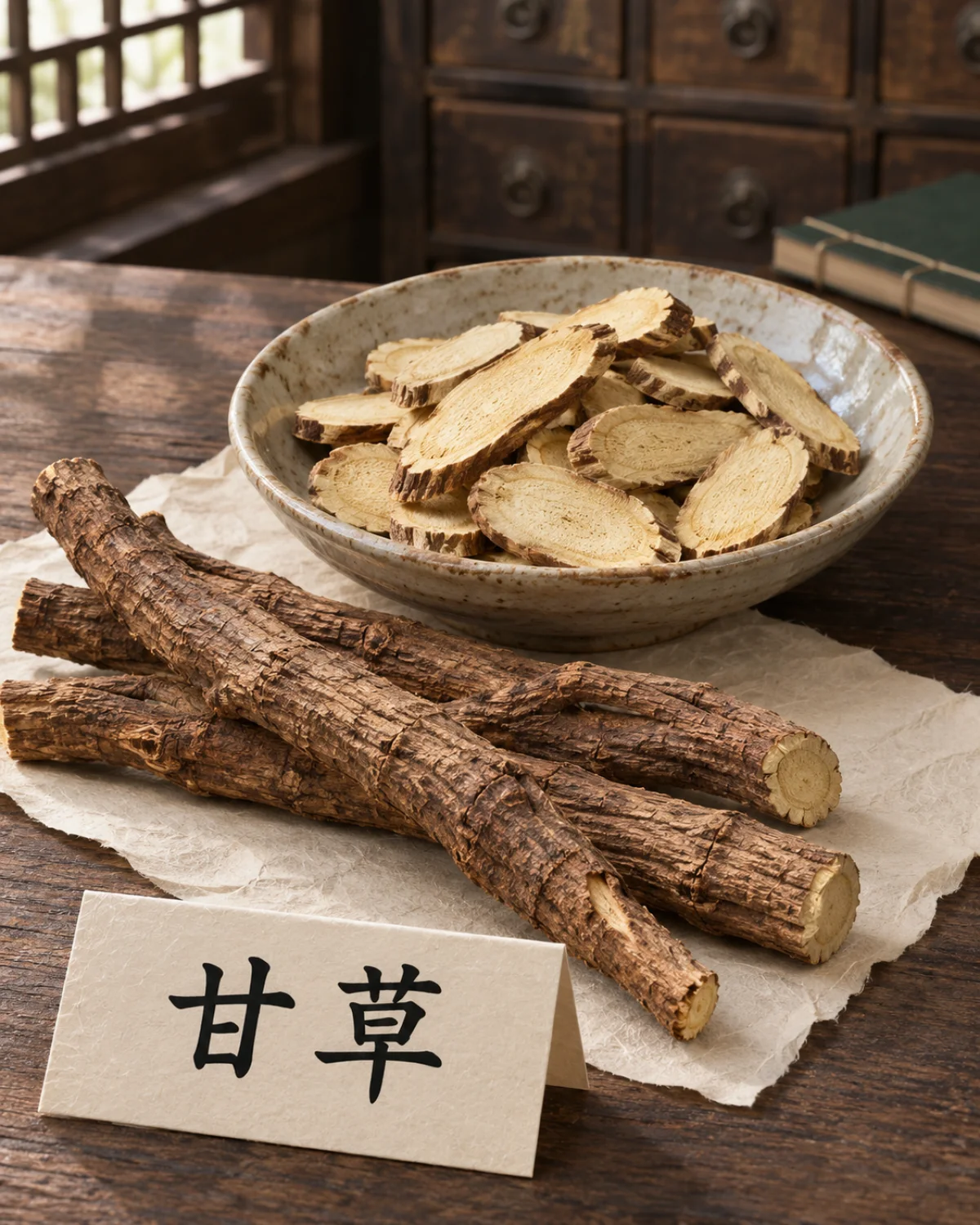
When looking at licorice, sweetness is what is easiest to remember; if starting from the material, however, one should first look at the part used. The licorice entry from Hong Kong Baptist University records the dried root and rhizome as its object: the outer layer has longitudinal lines, and the cut surface is relatively pale, showing fibrous and powdery texture. Whole material, oblique slices, and finer fragments each present different angles of observation.
The root and the rhizome are not the same plant part, and the bud scars and central structures in the records serve precisely to remind us to note this distinction. When reading other standards or product labels, one must also compare the listed botanical sources item by item. The Chinese name provides an entry point, while the botanical name and plant part narrow the scope; saying only "licorice taste" or seeing a yellow cut surface is still insufficient to account for the complete identity of a material.
CHAPTER 02
The chrysanthemum-heart pattern
The cut surface of licorice is sometimes described as a "chrysanthemum heart." This name does not mean that chrysanthemum has been mixed into the material; rather, it uses the flower form to aid memory: the tissues within the cut surface are arranged radially, visually evoking petals opening outward. Placing the term beside an enlarged image of the cut surface makes it possible to understand the actual structure to which the metaphor points.
Such terms display the observational power of traditional material identification and also remind readers not to understand them only literally. Returning to the licorice entry, one should still look at the outer bark, longitudinal lines, fracture surface, and records of root or rhizome together. A single pattern should not be expanded into full proof of source, quality, or effect; images make details visible, while complete material records give these details a context that can be checked.
CHAPTER 03
Licorice and prepared licorice: keeping names precise
A single item of licorice under a formula name may also carry differences in preparation form. When reading prepared licorice (zhigancao), the character "zhi" should be retained in notes and material comparisons, because it indicates that the entry points to material that has undergone the corresponding preparation. The color, surface, and texture of the slice can serve as observational clues, but the actual identity must still be jointly accounted for by name and record.
In formula discussion, licorice is often linked with traditional language such as harmonizing. When understanding it, one should look at what combination it appears in and how the author explains the relationships among materials; "harmonizing" cannot be expanded into a guarantee that can offset the risks of other drugs. Likewise, licorice flavor in food, the medicinal material itself, prepared forms, and extracts each have their own contexts; only by writing the preparation name and usage situation completely can one read clearly which kind of object different sources are actually discussing.
CHAPTER 04
A familiar herb, and important safety information
Licorice appears in everyday products and traditional combinations, but familiarity cannot replace safety judgment. Glycyrrhizic acid, commonly seen in modern information, is on a different level from material names, sweetness impressions, and product formulas; when reading research or labels, one should first clarify the component and product being discussed, then read its explanation of the usage situation.
The U.S. NCCIH reminds that licorice products containing glycyrrhizic acid may cause serious adverse reactions, and those with certain cardiovascular or kidney problems especially need to take note; there is also information on drug interactions. This information should be read seriously together with materia medica culture, and not omitted because something is "common" or "harmonizing." The depth of understanding licorice lies both in seeing the texture of the root slice and in distinguishing what traditional explanations, product identity, and individual medication assessment each answer.
INGREDIENTS
Constituents & parts
The medicinal material of licorice involves the root and rhizome, and the botanical source must be checked against the standard being used. This article takes the morphology of Glycyrrhiza materials, the texture of cut slices, and the names of prepared forms as its main thread, and reads glycyrrhizic acid-related research and safety information without inferring usability from sweetness.
HISTORY
Origins & stories
Licorice frequently appears in discussions of traditional combinations, and "harmonizing" has thus become a distinctive reading clue for it. This term must be understood within formula discussion and read alongside material source, preparation names, and modern safety information, so that a herb familiar in culture is not mistaken as universally applicable.
SAFETY
Reading & safety notes
Licorice products containing glycyrrhizic acid may cause serious adverse reactions and interact with medications; those with high blood pressure, heart or kidney problems, or who are taking medication should first consult a doctor or pharmacist.
THE READING ROOM
References
Herbal workshop scene; not a historical artifact, identification plate or record of brand manufacturing.
Editorial update · 2026-11-16