THE HERBAL ARCHIVE NO. 004
Astragalus root
Astragalus membranaceus / A. mongholicus
Fabaceae · root
Compare the written names 黃芪 and 黃耆, then examine the contrasting colours of an Astragalus root slice and the meaning of honey-processing names. Read traditional qi theory, material preparation and modern research in their respective contexts.
6 min read

CHAPTER 01
黃芪 and 黃耆: two written forms, one reading trail
When looking up Astragalus, one may encounter the Chinese written forms 黃芪 and 黃耆, both read as Huangqi. Placing the two forms in the same reading note helps connect different articles and material labels; but the comparison of names is still only a beginning, and next one must look at the plant sources listed in the entry and whether the parts used are all root materials.
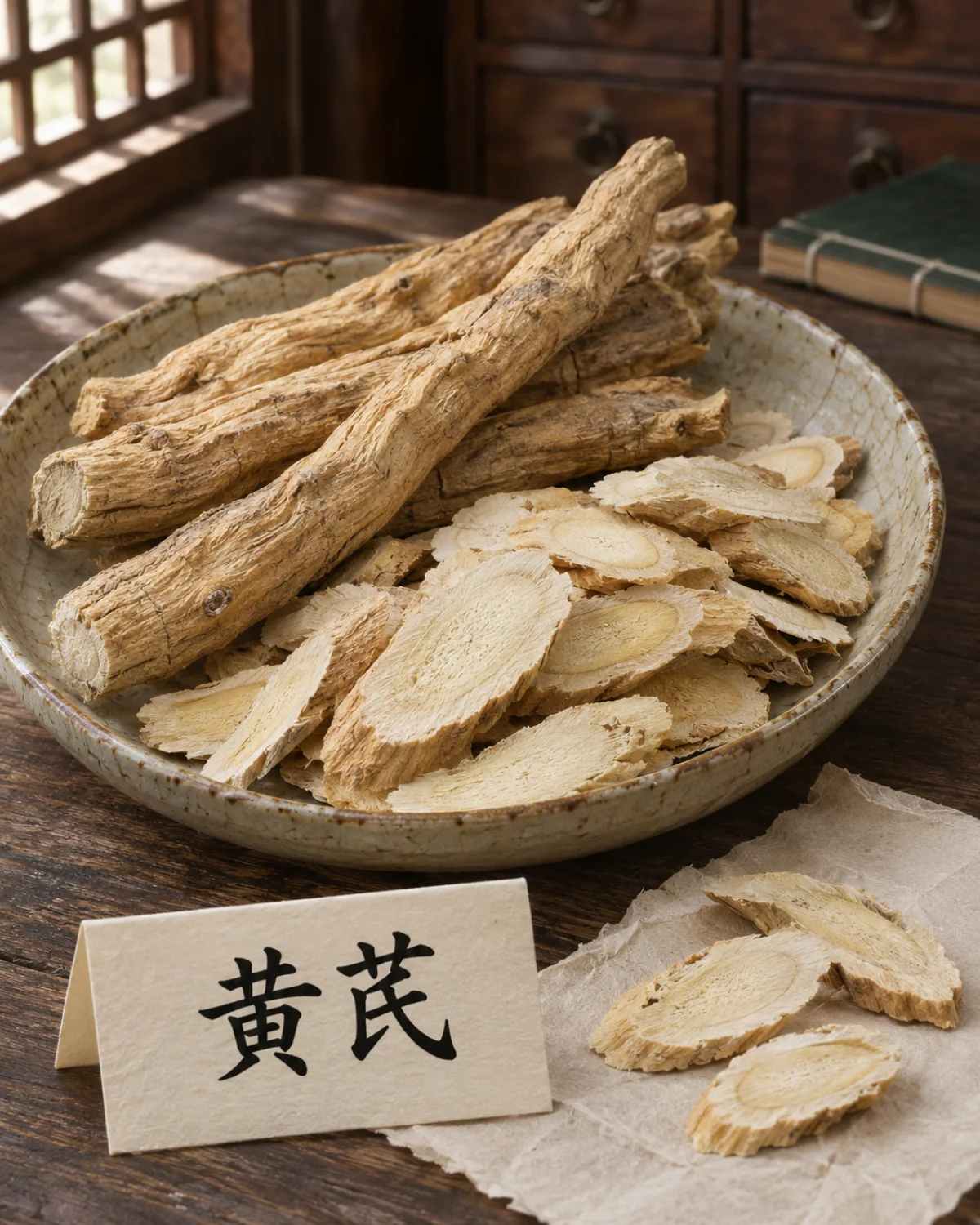
The Huangqi record from Hong Kong Baptist University lists related plant sources and takes the dried root as the object of observation. The root body is relatively long, longitudinal lines are visible on the exterior, and after cutting it shows inner and outer layers. When comparing different materials, scientific names sometimes appear in different taxonomic forms and should be read together with the records of their respective entries, rather than omitting verification simply because the Chinese characters are the same. Only in this way can a common name be grounded in a recognizable and traceable root material.
CHAPTER 02
The golden-cup and silver-plate metaphor
A transverse section of Huangqi often makes the layers easier to see than a whole root. In traditional morphological description, "golden cup and silver plate" uses the contrast of gold and silver to remember the visual relationship in which the wood portion tends toward yellow and the outer bark portion is whiter. This metaphor is not decorative praise, but an observational prompt that links position and color.
When reading an image, one may first find the outer edge of the slice, then see how the center and periphery are distributed, while also noting the texture of fibers and powdery quality. If "golden cup and silver plate" is treated only as a commercial slogan, the structure it originally points to will be missed. Conversely, one cannot judge the quality of an entire batch of material from a single photograph with beautiful color; external description needs to be checked against source, specifications, and other records before it has clear meaning.
CHAPTER 03
Prepared Astragalus: what the name records
Huangqi and Zhi Huangqi should not be abbreviated into the same short form when reading. The entry from Hong Kong Baptist University links Zhi Huangqi with names such as honey-fried Huangqi, indicating that the preparation name contains information about material processing. Understanding this name focuses on knowing which material a record describes, not on rewriting the text into household operating procedures.
In the workshop, the history of a piece of root material includes not only plant source and part but also preparation form and corresponding labeling. When comparing formula books, commodities, and research, these fields should first be aligned before discussing their relationships. If a study uses an extract, or if the literature explicitly lists a certain zhi product, it cannot be directly replaced by another material; the extra character in the name may be exactly the clue needed to keep the record accurate.
CHAPTER 04
Traditional qi theory and constituent research
In traditional formula discussion, Huangqi is often connected with the language of supplementing qi. These texts need to be placed back into the context of combination and theory, carefully observing how the author arranges the role of the material; one cannot simply because the word "qi" brings to mind spirit or physical strength add some modern physiological effect to the ancient text.
Research materials may also discuss the polysaccharides, saponins, or flavonoids of Huangqi. Constituent groups provide research directions, but they do not automatically equal clinical results, and still less can every product of the same name share a conclusion. The U.S. NCCIH points out that reliable evidence for the health uses of Huangqi is still insufficient, and research quality also requires attention. When reading results, look back at the material, research subjects, and observed indicators, and arrange them in layers with traditional explanations, so that both ancient and modern materials may each retain clear boundaries.
INGREDIENTS
Constituents & parts
Huangqi takes the dried root of related Astragalus plants as its medicinal material, and the source must be checked against the entry and standards. This text observes the longitudinal lines of the root body and the color of the bark and wood portions in cross-section, and compares material names such as Huangqi and Zhi Huangqi, as well as ways of reading constituent groups such as polysaccharides and saponins.
HISTORY
Origins & stories
The two written forms "黃芪" and "黃耆" cause the same material to appear under different characters in different articles. Placing the name comparison together with plant sources and root records allows one to enter the materia medica along the text; the "golden cup and silver plate" on the cut surface preserves an observational method that remembers materials through images.
SAFETY
Reading & safety notes
Those with autoimmune disease, those using immunosuppressive drugs, or those using other medications should first confirm with a doctor or pharmacist. During pregnancy and breastfeeding, Huangqi products should not be chosen on one's own.
THE READING ROOM
References
Herbal workshop scene; not a historical artifact, identification plate or record of brand manufacturing.
Editorial update · 2026-11-16